Mumbai-the financial capital of India, is the most populous of Indian cities with 1.58 sq.m per capita open space which is projected to further reduce to 0.87 sq.m (Source: Open Mumbai: Re-Envisioning Open Spaces by P. K. Das).
The per capita open space in London is 31.68 sq.m whereas in New York the per capita open space is 26.4 sq.m (Source: Open Mumbai: Re-Envisioning Open Spaces by P.K. Das). As compared to its national and global counter parts, Mumbai has the least per capita open space falling below the minimum per capita open space of 10-12 sq.m specified in the URDPFI (Urban Regional Development Plans Formulation and Implementation) Guidelines, 2014.
In a space deprived city like Mumbai, public open spaces are rare and highly valued for the role they play in ensuring human well-being and enriching community life. However, seldom do we recognize these spaces for their environmental roles, a factor that is becoming of vital importance in the current scenario of global warming induced changing weather patterns coupled with rising sea-levels that are causing frequent flash floods in the city. As there is no recognition for their environmental roles, preservation, protection and conservation status for such open spaces remains beyond the cone of vision. This article discusses one of the many such open spaces in the city of Mumbai-The Mahalaxmi Racecourse.
MAHALAXMI RACECOURSE
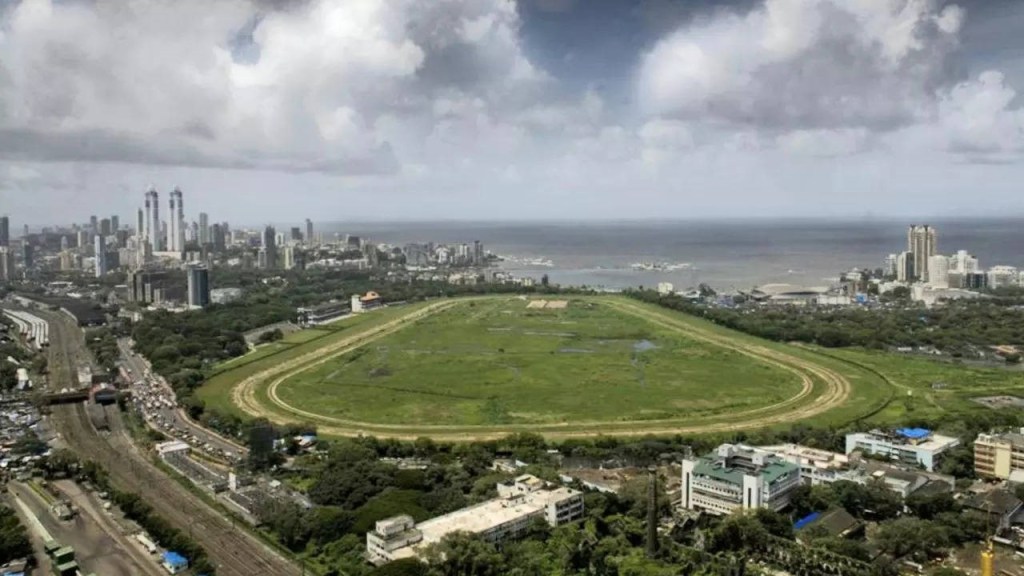
Source: ddp-thorat @ddpthorat (https://www.timesnownews.com/mumbai/mahalaxmi-racecourse-may-be-shifted-from-south-mumbai-to-mulund-dumping-grounds-theme-park-to-come-up-in-its-place-article-96901706)
For the unversed, Mahalaxmi racecourse is a horse racing track spread over an area of 225 acres of open land in the heart of Mumbai City. The Mahalaxmi Racecourse has been in the headlines lately due to a proposal of relocating the Racecourse from its current location in the city to Mulund dumping ground located in the Suburban Region of Mumbai Metropolitan Region. The Mahalaxmi Racecourse is proposed to be developed as a themed park in the future.
GEOGRAPHY OF MAHALAXMI RACECOURSE
Known for its high profile horse races, the Racecourse is situated near Breach Candy. Breach Candy a rather humorous but apt name derived from Breach + Candy-an anglicized word for Khind (Source: The Rise of Bombay by S. M. Edwardes) reveals a very peculiar landscape identity of the region – the existence of a Breach (Breach 05) between the Cumballa Hill forming part of Mumbai Island and Worli Hill forming part of the Worli Island from where the sea-water would gush in during the high tide as indicated in Fig. 02.
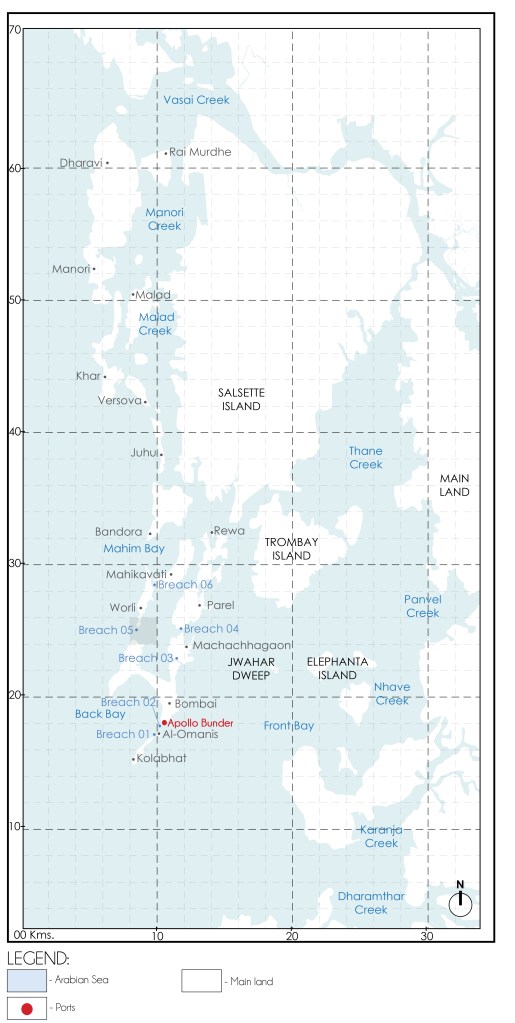
Source: Author
This gushing sea water was a cause of major concern for the British when they undertook the task of connecting the 7 Islands forming the Archipelago of Mumbai.
The confluence of the saline water and fresh water of streams gushing from the surrounding Cumballa Hill and Worli Hill created conducive conditions for the growth of marshes in the low lying area forming the Mahalaxmi flats.
These marshy lands were subject to the processes of plant colonization and eventually developed into mangroves.
The gushing water entering through the breach between the Cumballa Hill and Worli Hill during High Tides
would inundate the low lying areas up to Bombay Island in the South, Machhachagaon Island in the East and Parel Island in the North as highlighted in the ‘Description of Mumbai’ by Govind Madgaonkar,
The gushing water entering through the breach between the Cumballa Hill and Worli Hill during High Tides would inundate the low lying areas up to Bombay Island in the South, Machhachagaon Island in the East and Parel Island in the North as highlighted in the ‘Description of Mumbai’ by Govind Madgaonkar, ‘The Rise of Bombay’ by S. M. Edwardes and inferred by overlaying the present day drainage network simulation of Mumbai city on the map of Mumbai city and its environs dating back to 1650, indicated in Fig. 03.
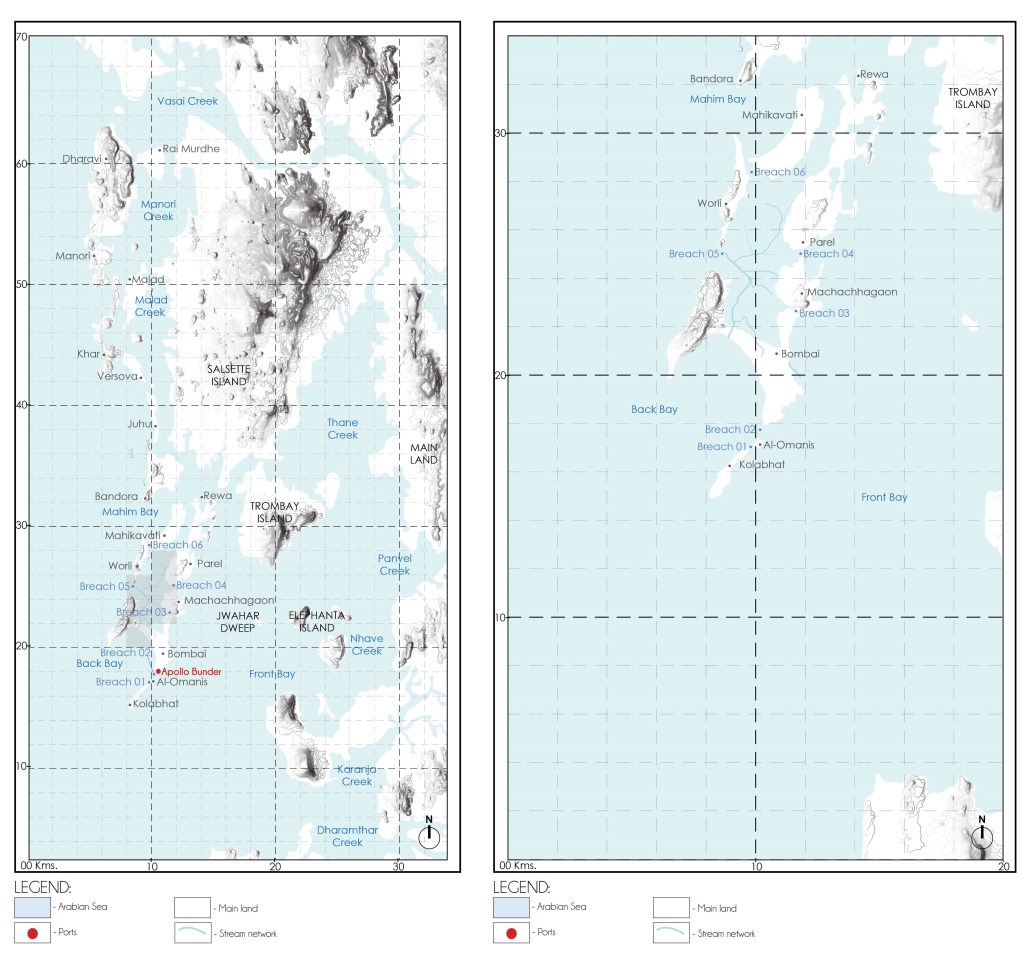
Source: Drawn by Author based on G.I.S. simulation of drainage network.
THE BREACH: AN ENGINEER’S DILEMMA
Keeping this gushing sea-water from entering into the island city was a nightmare for many engineers right from the commencement of the engineering project in 1720 A.D. under the leadership of East India Company’s Chief Engineer Mr. Bates. Despite of multiple attempts at creating sea walls, the force of the sea would destroy all engineering genius and find its way into the island city. It was only under the leadership of Governor Hornby (1772-1784) that the Hornby Vellard was constructed. This attempt was more successful than the previous attempts and exists till date but is not full proof as during the highest high tide the sea water still enters into the island city and finds it way towards the low-lying areas.
Fig. 04 indicates the Drainage Simulation for the Island city wherein Mahalaxmi Racecourse is the first space to be impacted when sea water enters the island city in the event of a highest high-tide.
Being a non-concrete, sponge like surface the racecourse bears the potential to absorb sea-water to some extent.
In the event of torrential rainfall coupled with High Tide, when the Racecourse is saturated the excess water follows the lay of land and travels through the Central parts of Mumbai City flooding the low-lying areas of Dadar, Matunga up to Sion in the North.
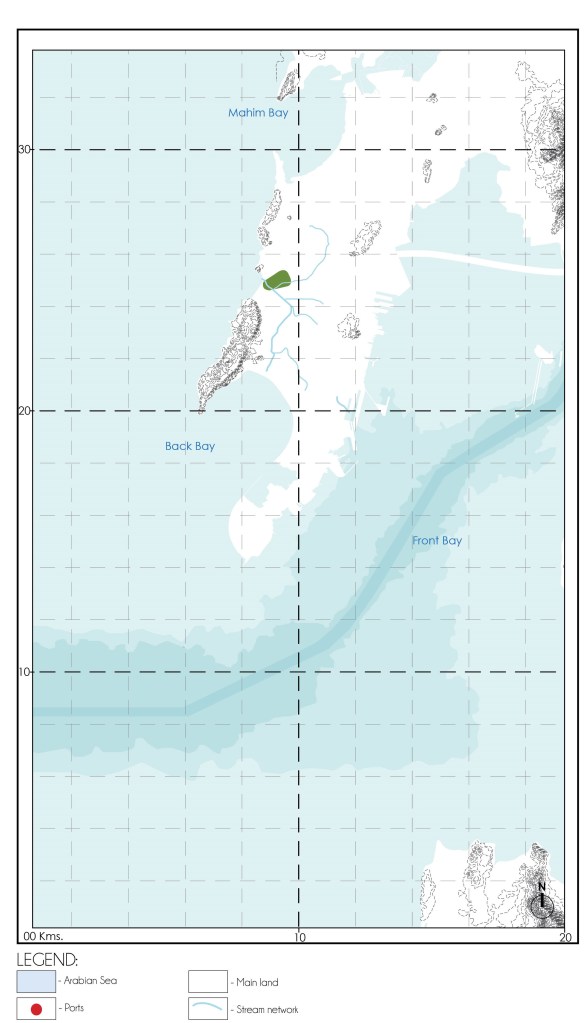
Source: Drawn by author based on G.I.S simulation of drainage network
MAHALAXMI RACECOURSE: AN ECO-WARRIOR
The Mahalaxmi Racecourse therefore acts as a sponge absorbing sea water during high tides and delaying flooding in the low-lying parts of Central Mumbai in the event of torrential rainfall coupled with highest high-tide. This environmental function performed by the Mahalaxmi Racecourse becomes increasingly important under the current scenario of global warming induced changing weather patterns, uncertain and heavy rainfall in a short duration and rising sea-levels due to melting of glaciers and natural expansion of water due to warming up.
The Sea Level Rise projection has predicted that by 2050, the surrounding Arabian Sea could flood the island city of Mumbai atleast once every year. With the rise in sea-level the frequency of sea-water entering into the island city would also increase thereby elevating the position of Mahalaxmi Racecourse as an environmental necessity to prevent flooding in the island city.
In the wake of such environmental projections should open spaces like the Mahalaxmi Racecourse that play the significant role of an Eco-warrior by actively trying to prevent damage to the populated areas of Mumbai City, be given the status of a mere open space which can be debated over for further development? Is it not time to recognize the role of these spaces in protecting the inhabited regions? Is it not time to elevate their status quo in the wake of environmental crisis?
WAY FORWARD
With the near future of coastal cities threatened, there is a need to identify the spaces that have been performing the role of eco-warriors silently guarding the world’s most populated regions from the adverse impacts of global warming. It is the need of the hour to recognize these spaces for their environmental roles in order to ensure conservation, preservation and enhancement of their roles in safe guarding the world’s most densely inhabited areas-coastal cities.

 Terrain Tapestry
Leave a reply to saee Cancel reply